
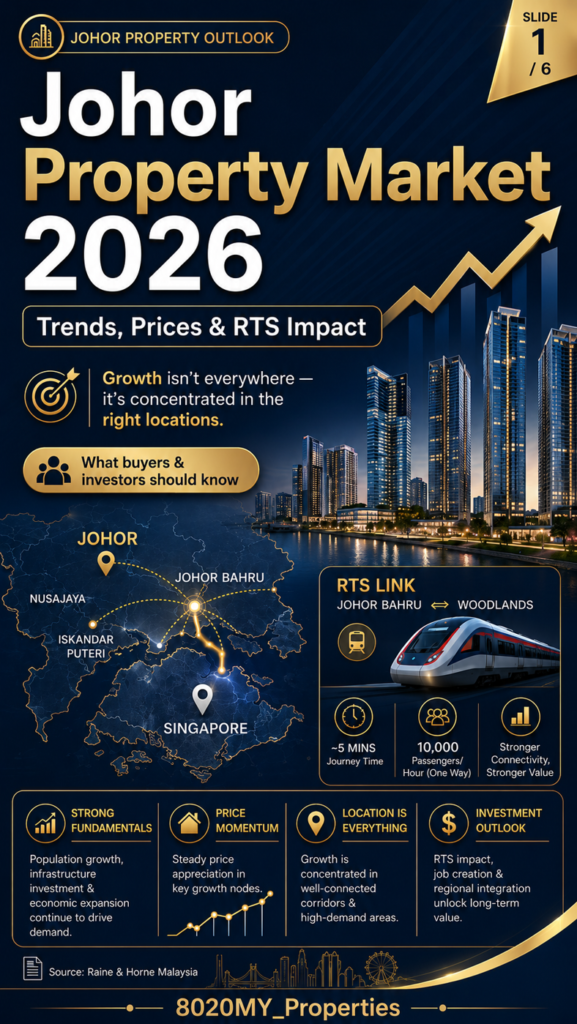
Growth is not everywhere. In 2026, Johor’s strongest opportunities are concentrated in the right micro-locations.
Johor Property Market Outlook 2026: RTS Link, Prices, Risks and Areas to Watch
Johor is entering one of the most closely watched phases in its property cycle. The state is benefiting from stronger cross-border integration with Singapore, major transport investment, expanding business activity and growing interest in well-connected residential locations. Yet the opportunity is not evenly distributed.
In 2026, the strongest performance is likely to remain concentrated around established employment centres, transport nodes, mature townships and areas with genuine rental or owner-occupier demand. For homebuyers and investors, this means the old strategy of buying any development simply because it is “near Singapore” is no longer enough. Location quality, accessibility, surrounding amenities, practical unit layouts, supply conditions and the depth of the tenant pool will matter far more than marketing promises.
Johor still offers compelling long-term potential. However, success increasingly depends on precision rather than broad exposure. The most resilient assets are likely to be properties that serve a clear everyday purpose: a convenient home for a commuter, a family residence near schools and healthcare, or a rental property supported by nearby employment and transport.
Johor Property Market 2026 at a Glance
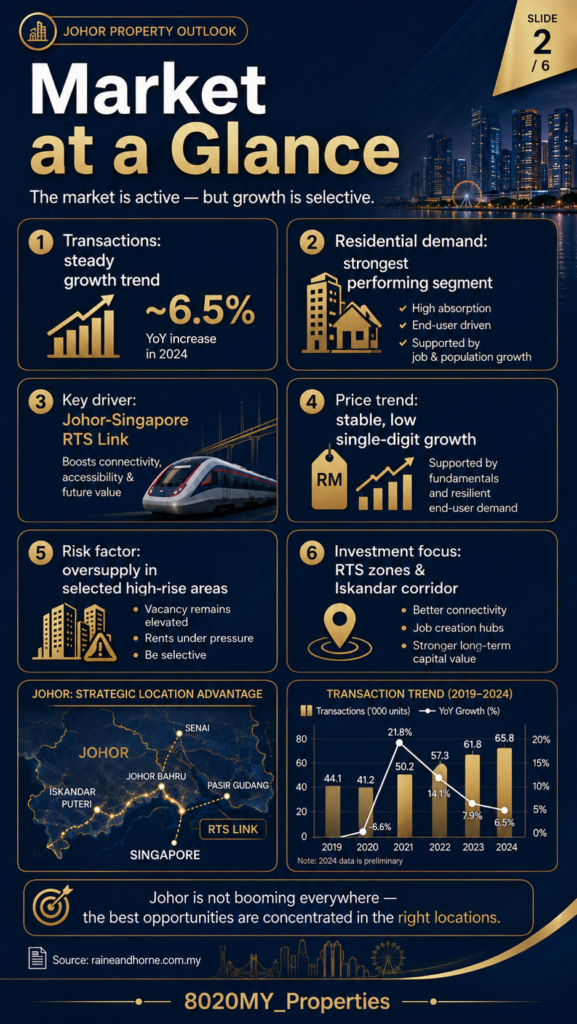
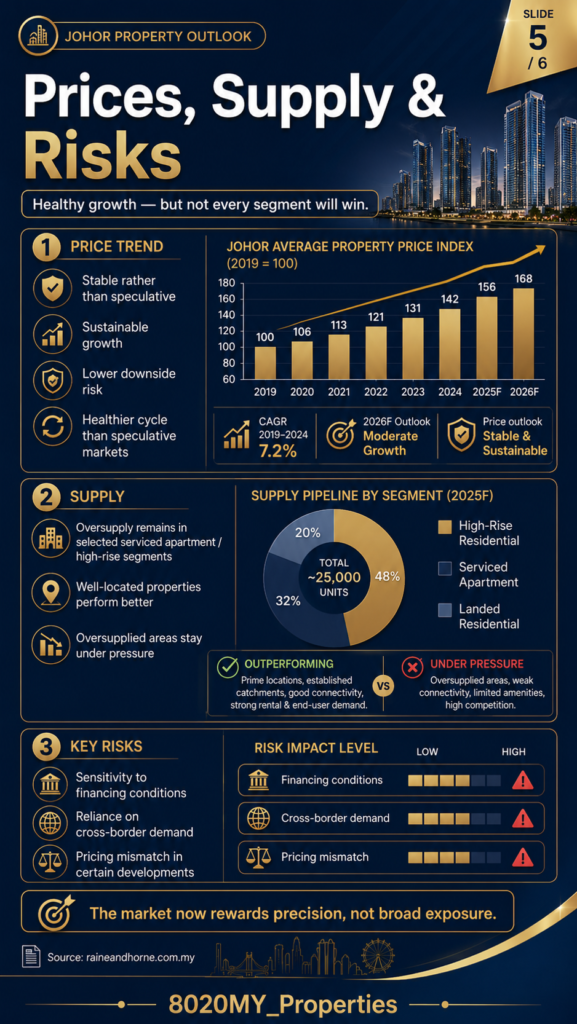
Raine & Horne Malaysia’s 2026 Johor market commentary describes the state as one of Malaysia’s strongest growth corridors. Its outlook points to resilient residential demand, improving connectivity, business expansion and increasing cross-border integration. The same analysis reports an approximate 6.5% year-on-year increase in property transactions in 2024 and characterises the price trend as stable, with low single-digit growth rather than a broad speculative surge.
The broader message is positive but selective. Well-positioned properties may continue to appreciate, while oversupplied high-rise or serviced-apartment pockets can remain under pressure. Properties supported by jobs, schools, healthcare, retail amenities and reliable transport connections are more likely to remain usable and liquid across different market cycles.
Why the Johor Property Market Is Growing
1. Cross-Border Demand from Singapore
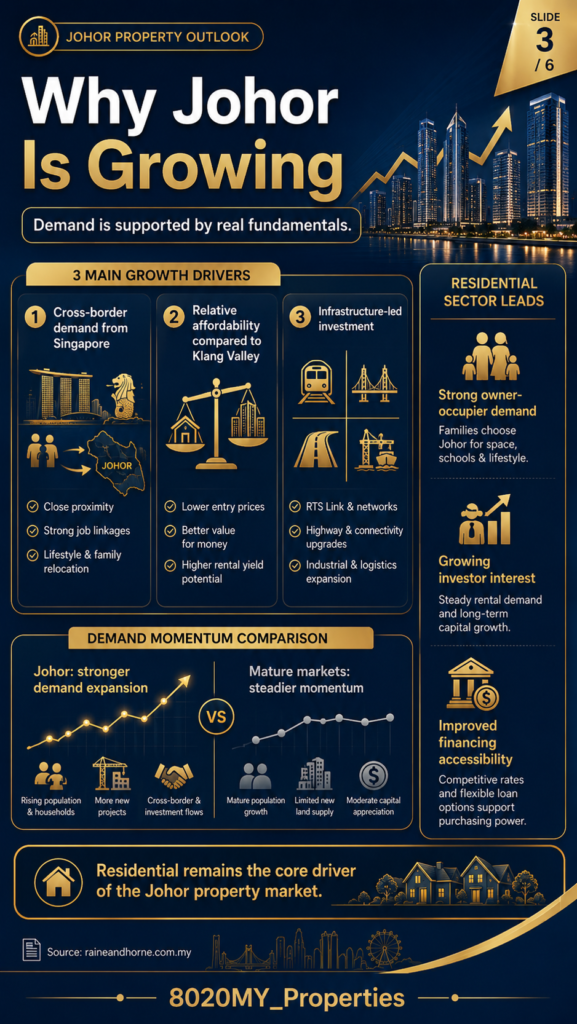
Johor’s relationship with Singapore is one of its most important structural advantages. The state attracts Malaysians working in Singapore, Singapore-based families seeking more living space, retirees considering a lower-cost lifestyle and businesses exploring a complementary operating base across the border.
This demand is not limited to investors. Owner-occupiers are an important part of the market, particularly in family-oriented townships with international schools, healthcare facilities, shopping centres and established communities. Their presence supports a healthier market because demand is linked to real usage rather than purely speculative resale expectations.
2. Relative Affordability and Lifestyle Value
Compared with Singapore and many mature urban locations in the Klang Valley, Johor can offer larger homes, newer facilities and lower entry prices. This value proposition is especially attractive to buyers who prioritise space, family lifestyle and long-term usability.
Affordability should nevertheless be measured using the total cost of ownership. Buyers need to consider maintenance charges, sinking funds, financing costs, renovation, insurance, assessment tax, quit rent and the cost of leaving a unit vacant. A property is not truly affordable if its monthly holding cost is difficult to sustain.
3. The Johor-Singapore Special Economic Zone
The Johor-Singapore Special Economic Zone, or JS-SEZ, adds another layer to Johor’s long-term growth story. Official investment materials identify nine flagship zones and eleven priority sectors, including manufacturing, logistics, digital economy, financial services, tourism, education, health, energy and the green economy.
As businesses expand and new employment clusters develop, housing demand may strengthen near industrial parks, commercial centres, education hubs and major transport corridors. Property investors should therefore study where jobs are actually being created. Sustainable rental demand is usually strongest when residents have a practical reason to live in a location throughout the year.
How the RTS Link Could Reshape Property Demand
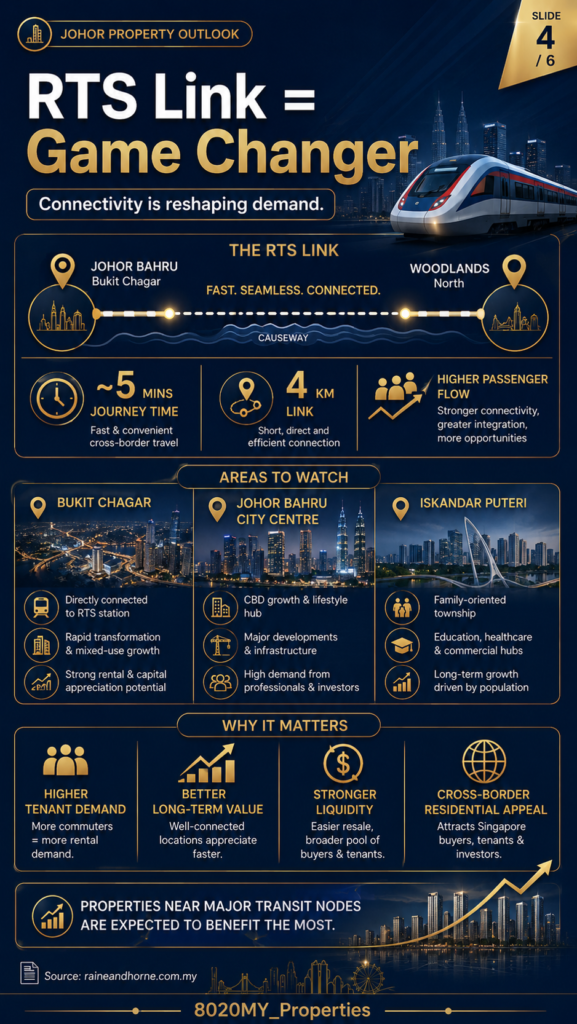
The Johor Bahru–Singapore Rapid Transit System Link is one of the most significant catalysts for the market. Official project information describes an approximately four-kilometre rail connection between Bukit Chagar in Johor Bahru and Woodlands North in Singapore. The system is designed to carry up to 10,000 passengers per hour in each direction during peak periods, with a train journey of about five minutes between the two stations.
Passengers are also expected to clear both Malaysian and Singaporean immigration at the departure station through co-located customs, immigration and quarantine facilities. This could make regular cross-border travel more predictable and convenient, particularly for commuters who currently depend on road transport. Passenger service is targeted for the end of 2026, subject to project completion and operational readiness.
From a property perspective, the RTS Link is likely to strengthen interest in transit-accessible locations. However, the impact will not be identical across every project marketed as “RTS-related”. Buyers should assess the real door-to-door journey, including walking distance, feeder transport, parking availability, congestion, interchange time and access to daily amenities.
Areas to Watch in the Johor Property Market
Bukit Chagar and Johor Bahru City Centre
Bukit Chagar is the most direct beneficiary of the RTS Link because it hosts the Johor terminus. Nearby areas may benefit from commuter demand, urban regeneration, retail activity and mixed-use development. Yet city-centre investing requires careful project-level analysis. Traffic flow, pedestrian access, parking, management quality and competing supply can significantly affect rental performance.
Iskandar Puteri
Iskandar Puteri remains attractive for buyers seeking a more family-oriented environment. The area includes established townships, education institutions, healthcare facilities, leisure attractions, commercial nodes and access to major highways. Its investment case is less dependent on one transport project and more closely linked to long-term population growth, business expansion and lifestyle demand.
Established Growth Corridors
Other opportunities may emerge around employment nodes, industrial clusters, logistics hubs and mature residential communities. The key is to identify locations where infrastructure and economic activity already support daily demand. A completed neighbourhood with shops, schools, transport and occupied homes often presents lower execution risk than a distant project that depends on multiple future developments.
Prices, Supply and the Main Risks
Johor’s 2026 outlook is better described as steady than speculative. Well-located properties may experience moderate appreciation, but rapid price growth should not be treated as guaranteed. Financing conditions, buyer affordability and the volume of new supply will continue to influence performance.
Oversupply is the most visible risk in selected high-rise and serviced-apartment segments. A large number of similar units can create intense competition among landlords, leading to longer vacancy periods, furnishing incentives and pressure on rents. Investors should compare active rental listings, completed units, future launches and actual occupancy—not only projected yields shown in sales materials.
Other risks include dependence on cross-border demand, changes in mortgage rates, weak property management, unrealistic asking prices and buying a unit that does not match the needs of the local tenant pool. A property can be in a promising district but still underperform because of poor layout, high maintenance charges or excessive competition within the same development.
What Homebuyers Should Do
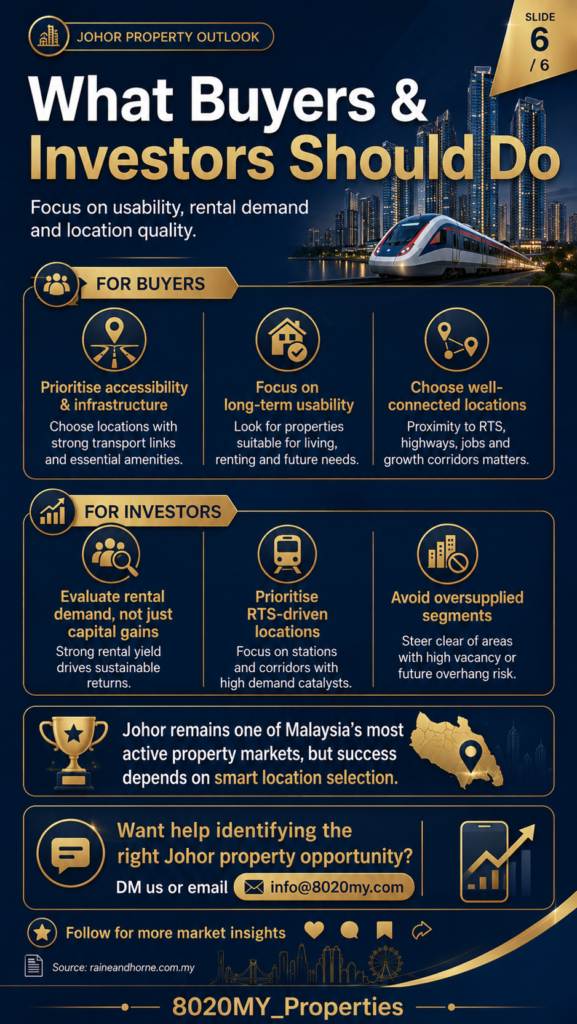
Homebuyers should begin with practical needs rather than short-term price forecasts. Consider daily travel time, schools, healthcare, safety, neighbourhood maturity, maintenance quality and whether the property can support changing family needs over the next five to ten years.
It is also important to stress-test affordability. Calculate the monthly instalment under a higher interest-rate scenario and include maintenance charges, insurance, taxes and renovation costs. Buyers should review the sale and purchase agreement, title conditions, developer track record and expected completion timeline with qualified professionals before committing.
What Property Investors Should Do
Investors should focus on rental demand first and capital appreciation second. Study who the likely tenant is, why that tenant would choose the location and how much comparable completed units are actually renting for. Gross yield projections should be adjusted for vacancy, agent fees, maintenance, repairs, furnishing replacement and financing costs.
Properties near the RTS Link or major highways may be attractive, but connectivity must be practical. The best opportunities are often assets that combine transport access with employment, retail, education and healthcare. Avoid relying on a single catalyst or buying into an oversupplied segment simply because the entry price appears low.
Johor Property Market Outlook: The Bottom Line
Johor remains one of Malaysia’s most compelling property markets in 2026. The RTS Link, JS-SEZ, business expansion and cross-border integration provide credible long-term growth drivers. Residential demand is likely to remain resilient, particularly in locations supported by employment, infrastructure and established amenities.
At the same time, the market is becoming more selective. Broad optimism should not replace detailed due diligence. Buyers and investors need to distinguish between genuine connectivity and marketing proximity, between sustainable demand and speculative interest, and between a well-managed property and one competing with hundreds of similar units.
The central lesson is simple: location still matters, but location must be assessed through usability, demand depth and long-term economic relevance. In the Johor property market of 2026, the best results are likely to come from choosing the right property in the right micro-location—not merely buying into the right headline.
| Need Help Identifying the Right Johor Property Opportunity? Whether you are buying for your own stay, retirement, rental income or long-term investment, 8020MY Properties can help you compare locations and identify options that match your objectives. DM us or email info@8020my.com |
Sources and Further Reading
• Raine & Horne Malaysia – Johor Property Market 2026
• Singapore Land Transport Authority – Johor Bahru–Singapore RTS Link
• MRT Corp Malaysia – RTS Link Project
• MIDA – JS-SEZ Guidelines and Flagship Zones
• MIDA – Iskandar Malaysia and the JS-SEZ
Disclaimer: This article is for general information only and does not constitute financial, legal or investment advice. Property performance varies by project, location, financing structure and market conditions. Buyers should obtain independent professional advice before making a commitment