
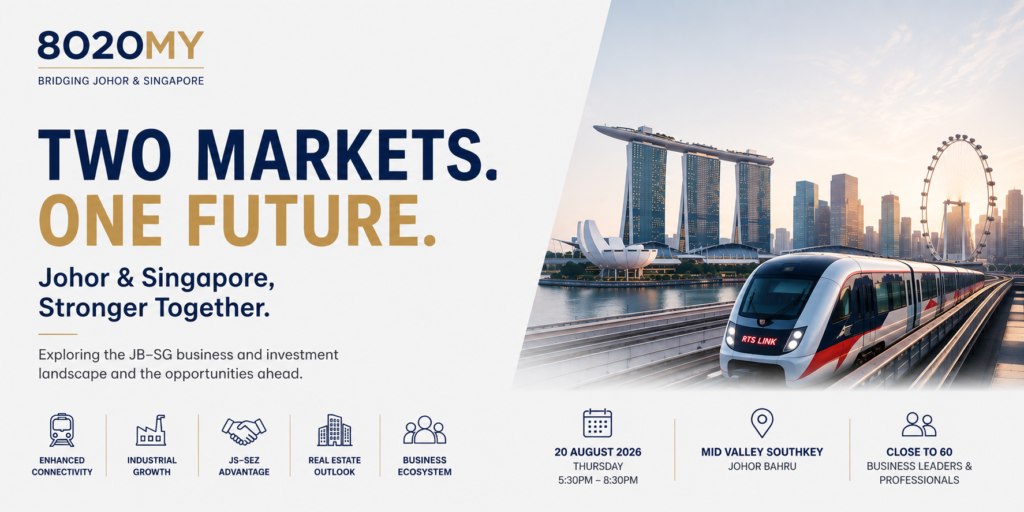
Johor and Singapore Are Moving Towards One Connected Business Ecosystem
The Johor–Singapore growth story is no longer driven by property alone. Infrastructure, industrial investment, talent, business mobility and the Johor–Singapore Special Economic Zone are beginning to reshape how companies view the region.
Suggested cover image: 01-event-cover.jpeg
I recently attended the MICCI Southern Region and IGB Monthly Get-Together at Mid Valley Southkey, where industry representatives shared their perspectives on the evolving Johor Bahru–Singapore business and investment landscape.
The event brought together close to 60 participants and covered three closely connected themes: the Johor property market, the Johor–Singapore Special Economic Zone, and the development of integrated business environments such as Mid Valley Southkey.
My biggest takeaway was this:
Johor should no longer be viewed simply as a lower-cost alternative to Singapore. It is increasingly developing into a complementary business, investment and lifestyle ecosystem.
Connectivity Is Becoming a Major Economic Driver
For many years, Johor’s main attraction was its proximity to Singapore.
Today, that proximity is being strengthened by physical infrastructure, policy coordination and increasing cross-border economic integration.
Projects connected to the RTS corridor, the Johor–Singapore Special Economic Zone and higher-value industries such as data centres and advanced manufacturing are increasingly influencing pricing, investment demand and business decisions.
The RTS Link is especially significant because it could change how people think about working, living and operating businesses across both sides of the Causeway.
The presentation indicated that the RTS is expected to provide a single immigration-clearance point at Bukit Chagar, while feeder services are being planned to improve connections to surrounding areas.
Suggested image: 04-rts-link.jpeg
Caption: The RTS Link could make cross-border commuting and business movement more predictable and convenient.
This is important not only for commuters. Better connectivity may influence:
- Where companies locate their offices
- Where employees choose to live
- Which properties attract sustained rental demand
- How Singapore companies serve customers and operate in Johor
- The ability of businesses to recruit talent from both markets
Johor’s Property Market Is Becoming More Selective
One of the most interesting observations from the property-market presentation was the emergence of a “two-speed” residential market.
Unsold completed high-rise condominium stock reportedly declined by approximately 27% year-on-year, while unsold landed housing stock increased. The speaker attributed part of this divergence to demand for properties offering cross-border commuting advantages.
This suggests that it is no longer sufficient to say that the Johor property market is either “good” or “oversupplied.”
Different locations and property types may perform very differently.
Properties near major transport infrastructure, established commercial centres and employment nodes could benefit from stronger demand. Meanwhile, projects without clear connectivity, tenant demand or a differentiated proposition may face more competition.
Suggested image: 02-speaker-property-market.jpeg
Caption: The Johor market is showing different levels of demand across high-rise, landed and infrastructure-linked properties.
For buyers and investors, the emphasis should therefore be on fundamentals:
- Who is the likely tenant or future buyer?
- Is the property connected to employment and commercial activity?
- Is the surrounding infrastructure already operating or still proposed?
- What competing supply will enter the market?
- Does the property remain attractive without relying entirely on the RTS narrative?
Connectivity can create a premium, but proximity alone does not guarantee a successful investment.
Industrial and Logistics Assets Remain a Strong Growth Area
Johor’s industrial and logistics sector was presented as one of the region’s strongest-performing real estate segments.
Foreign investors accounted for approximately 78% of approved industrial investment, with growth being supported by supply-chain diversification, advanced manufacturing, data centres and logistics operations.
However, the outlook is not without challenges.
Rising industrial land prices, labour shortages, higher operating costs, and limitations involving power and water supply may affect future development. Industrial properties with dependable utilities and infrastructure are therefore expected to command stronger demand.
Suggested image: 05-market-outlook.jpeg
Caption: Johor’s industrial market is benefiting from investment in data centres, manufacturing and regional logistics.
For Singapore businesses considering expansion into Johor, this reinforces the importance of looking beyond rental or purchase price.
A suitable factory or industrial facility must also be assessed according to:
- Power capacity
- Water availability
- Floor loading and ceiling height
- Labour accessibility
- Licensing requirements
- Logistics connectivity
- Expansion potential
- The permitted industrial use of the property
A cheaper facility can become expensive when its infrastructure does not support the company’s operations.
The JS-SEZ Is About More Than Tax Incentives
The Johor–Singapore Special Economic Zone was described through the concept of “two economies, one ecosystem.”
Its framework is built around four broad areas:
- Economic cooperation
- Easier movement of people and goods
- Talent development
- Greater ease of doing business
Suggested image: 03-js-sez-overview.jpeg
Caption: The JS-SEZ is intended to combine the strengths of Johor and Singapore as a gateway to ASEAN.
Targeted industries include manufacturing, logistics and food security, supported by sectors such as finance, digital services, healthcare, tourism, education and business services.
The long-term opportunity may therefore extend beyond large factories and multinational corporations.
Small and medium-sized businesses could also benefit by providing:
- Professional and corporate services
- Technology and digital solutions
- Recruitment and talent development
- Engineering and technical support
- Logistics and supply-chain services
- Healthcare and wellness services
- Training and education
- Food, retail and hospitality concepts
Large investments often create demand for an entire supporting ecosystem of service providers.
This is where Singapore SMEs may find practical opportunities—not necessarily by relocating their entire operations, but by establishing a Johor presence that supports regional growth.
Faster Approvals Could Improve Business Viability
A major concern when entering a new market is the time required to obtain approvals and begin operations.
During the presentation, a business facilitation initiative referred to as the Johor Superlink was said to have shortened construction-related processing time from approximately 24 months to 14 months.
Reducing approval timelines can make a significant difference to a project’s return on investment.
However, companies should still conduct proper professional assessment before committing capital. Tax incentives, licences, land use, foreign ownership rules and sector-specific approvals may depend on the nature and scale of the proposed investment.
Offices Are Becoming Business Ecosystems
The discussion on Mid Valley Southkey highlighted another important shift: companies are no longer choosing offices based only on rental rate and floor area.
Businesses are increasingly looking for locations that offer:
- Convenient access
- Retail and dining options
- Sufficient parking
- Modern building specifications
- ESG compliance
- Networking opportunities
- Amenities that help attract and retain employees
Mid Valley Southkey was presented as a “fringe-CBD” location approximately eight to ten minutes from the CIQ and RTS terminal, supported by more than 5,500 parking bays.
Suggested image: 06-mid-valley-southkey.jpeg
Caption: Integrated commercial hubs combine offices, retail, hospitality and lifestyle facilities within one location.
Its wider business ecosystem reportedly includes professional firms, logistics providers, accounting organisations, diplomatic representatives and real estate consultancies. This creates what the presenter described as an immediate “circle of trust” for businesses operating within the development.
This can be especially relevant for companies entering Johor for the first time. Being surrounded by established service providers and potential partners may reduce some of the friction involved in entering a new market.
What Does This Mean for Singapore Businesses?
The opportunities in Johor are real, but companies should avoid entering the market based on enthusiasm alone.
Before establishing an office, factory or investment presence, business owners should examine:
- The purpose of the Johor operation
- The customers it will serve
- Whether the company needs an office, industrial premises or flexible workspace
- Staffing and employment arrangements
- Tax, licensing and regulatory requirements
- Banking and cash-flow considerations
- Property ownership or tenancy structures
- How the Johor operation integrates with the Singapore business
The strongest cross-border strategies are usually not based purely on cost savings.
They are based on combining the capabilities of both markets.
Singapore can continue to provide access to capital, international networks, professional expertise and regional headquarters functions. Johor can provide land, operational capacity, industrial infrastructure, a growing consumer market and access to a wider workforce.
My Perspective
The Johor–Singapore economic relationship is entering a new phase.
The RTS Link may improve movement. The JS-SEZ may make investment and business establishment easier. Industrial and commercial development may create new opportunities for supporting businesses. Integrated hubs may also make Johor more attractive to companies and employees.
But not every location, property or business model will benefit equally.
The real opportunity lies in understanding where infrastructure, demand, policy and commercial activity come together.
For investors, this means selecting properties with a clear use case.
For companies, it means entering Johor with a defined operating strategy.
For Singapore SMEs, it means considering Johor not merely as a cheaper location, but as a platform for regional expansion.
Johor and Singapore may remain two separate jurisdictions, but economically, they are moving closer towards becoming one connected ecosystem.
The figures and timelines in this article were presented during the MICCI–IGB event on 20 August 2026. They should be independently verified before making property, business or investment decisions.